
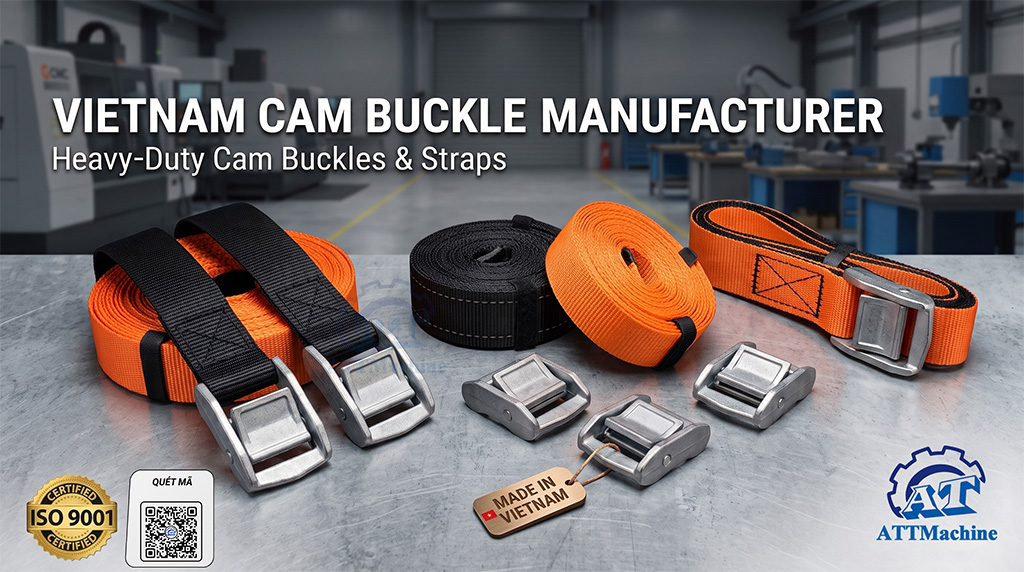
Cam Buckle Manufacturer for OEM, Wholesale & Tie-Down Applications
A cam buckle is a spring-loaded fastening component engineered for fast, manual strap adjustment without the mechanical spooling of a ratchet. In demanding B2B environments, system performance relies strictly on precise metal alloys, spring tension, and webbing compatibility.
ATT Machine manufactures both standard and custom OEM cam buckles - ranging from 25 mm to 50 mm (1 to 2 inches) - tailored for wholesale cargo control, marine equipment, and private-label tie-down applications.
What Is a Cam Buckle?
A cam buckle (or cam-lock) is a spring-loaded fastening component designed to quickly secure tie-down webbing using manual tension. Unlike ratchet buckles that use mechanical cranking, cam buckles rely entirely on hand-pulled tension, preventing over-tightening and protecting fragile loads.
How a Cam Buckle Works
The mechanism operates on a simple, fast-release principle designed for quick adjustments:
-
Press the thumb lever to lift and open the cam mechanism.
-
Feed the webbing through the bottom of the buckle.
-
Pull the strap manually to remove slack and reach the desired tension.
-
Release the lever so the spring-loaded teeth grip the webbing securely.
Engineering Insight: Because it does not wind the strap around a rotating spool, a cam buckle prioritizes speed, easy release, and controlled hand tension over sheer mechanical force. They are typically paired with standard polyester webbing and customized across various widths and metal alloys for specific B2B applications.
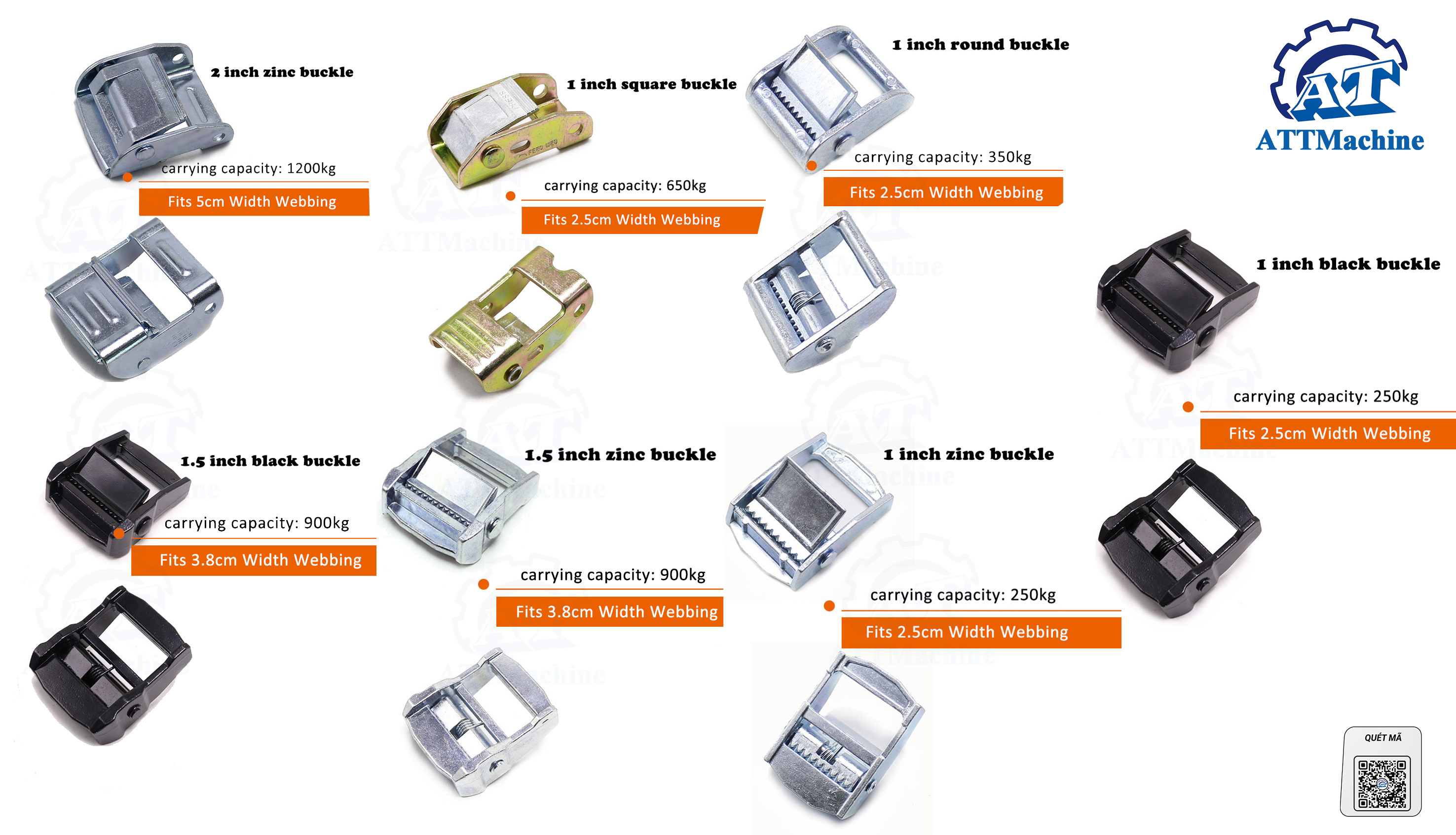
Cam buckle for tie down straps OEM VietNam Attmachine
Main Components of a Cam Buckle
A typical metal cam buckle consists of several functional components:
-
Cam – the moving component that grips the webbing.
-
Frame – the main structural body of the buckle.
-
Spring – returns the cam to its locking position.
-
Cam teeth or gripping surface – increases friction against the webbing.
-
Attachment point – connects the buckle to the strap or assembly.
The exact geometry of these components affects how smoothly the buckle operates and how securely it holds the webbing.
For OEM production, the buckle should therefore be evaluated together with the webbing rather than as an isolated component.
Cam Buckle Sizes: 1 Inch, 1.5 Inch and 2 Inch
Webbing width dictates your entire hardware profile. ATT Machine manufactures OEM cam buckles engineered for standard 1-inch, 1.5-inch, and 2-inch industrial strap assemblies.
Standard Cam Buckle Dimensions & Applications
| Size (Metric) | System Profile | Typical B2B Applications |
| 1 Inch (25 mm) | Compact & Quick-Release | Motorcycles, outdoor gear, roof racks, luggage, and small OEM equipment. |
| 1.5 Inch (38 mm) | Medium-Duty Interface | Kayaks, furniture transport, recreational equipment, and commercial accessories. |
| 2 Inch (50 mm) | Heavy-Duty Securing | Commercial cargo, equipment transport, trailers, and industrial freight. |
Engineering Warning: Buckle width does not dictate load capacity. The final Working Load Limit (WLL) depends on the complete assembly (metal, webbing, and stitching). Always request model-specific tensile test data.
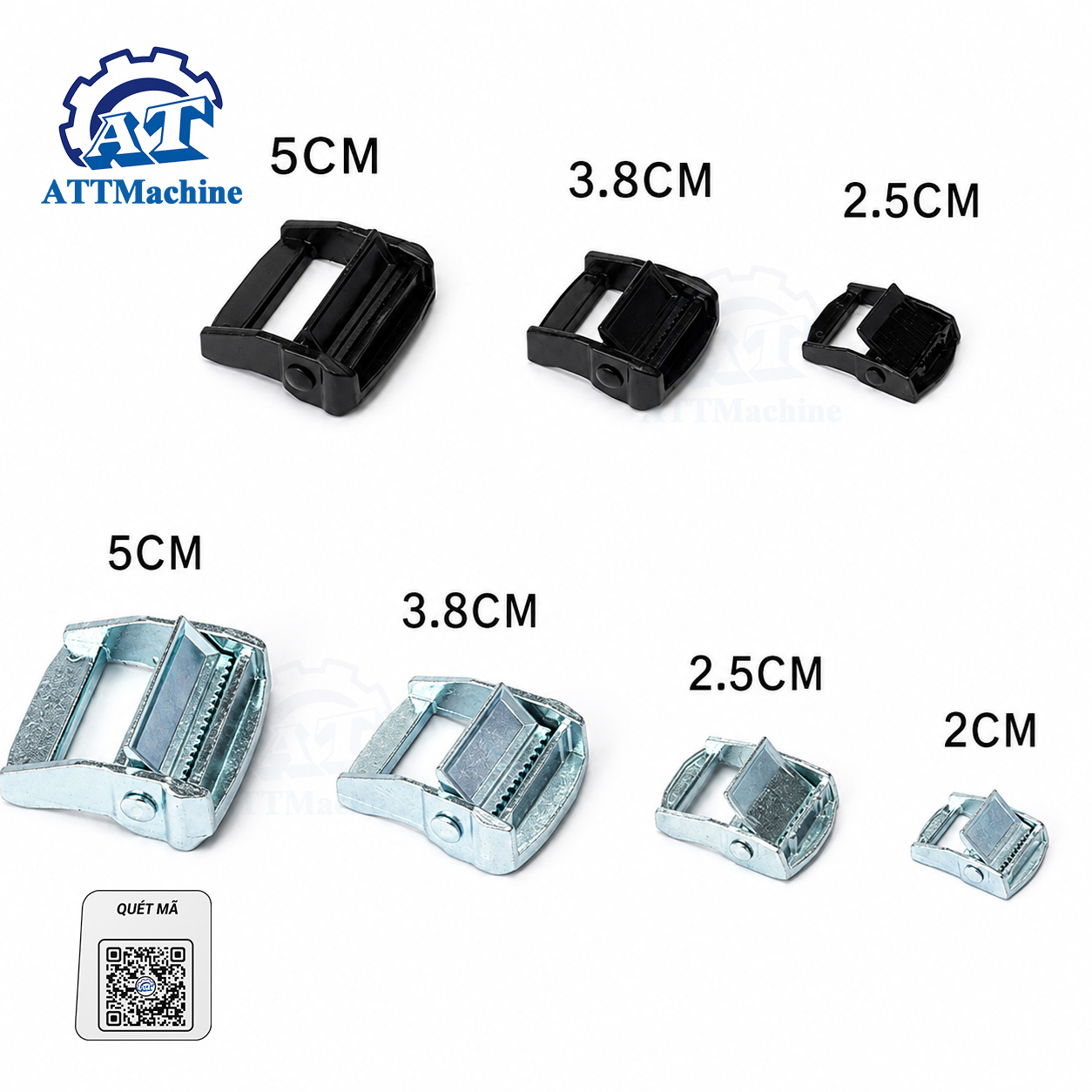
Best-Selling Cam Buckle Sizes at ATT Machine
Cam Buckle Materials & Surface Finishes
Material selection directly dictates a buckle's environmental resilience, service life, and production cost.
Standard Material Comparison
| Material Type | Core Advantage | Typical Environment | Surface Treatment |
| Carbon Steel | High strength & cost efficiency | Standard cargo & transport | Requires zinc plating or black coating for rust resistance. |
| Stainless Steel | Maximum corrosion resistance | Marine, humid, & long-term outdoor | Grade must be tailored to exact exposure conditions. |
OEM Customization & Branding
For private-label distribution, appearance and branding are integrated into the product specification. ATT Machine engineers custom configurations including:
-
Specialized surface colors and anti-corrosive coatings
-
Engraved or stamped logo markings
-
Custom B2B packaging solutions
Engineering Support: Submit your technical blueprints or physical samples. Our engineering team will review your specifications and recommend the optimal manufacturing configuration before initiating production.
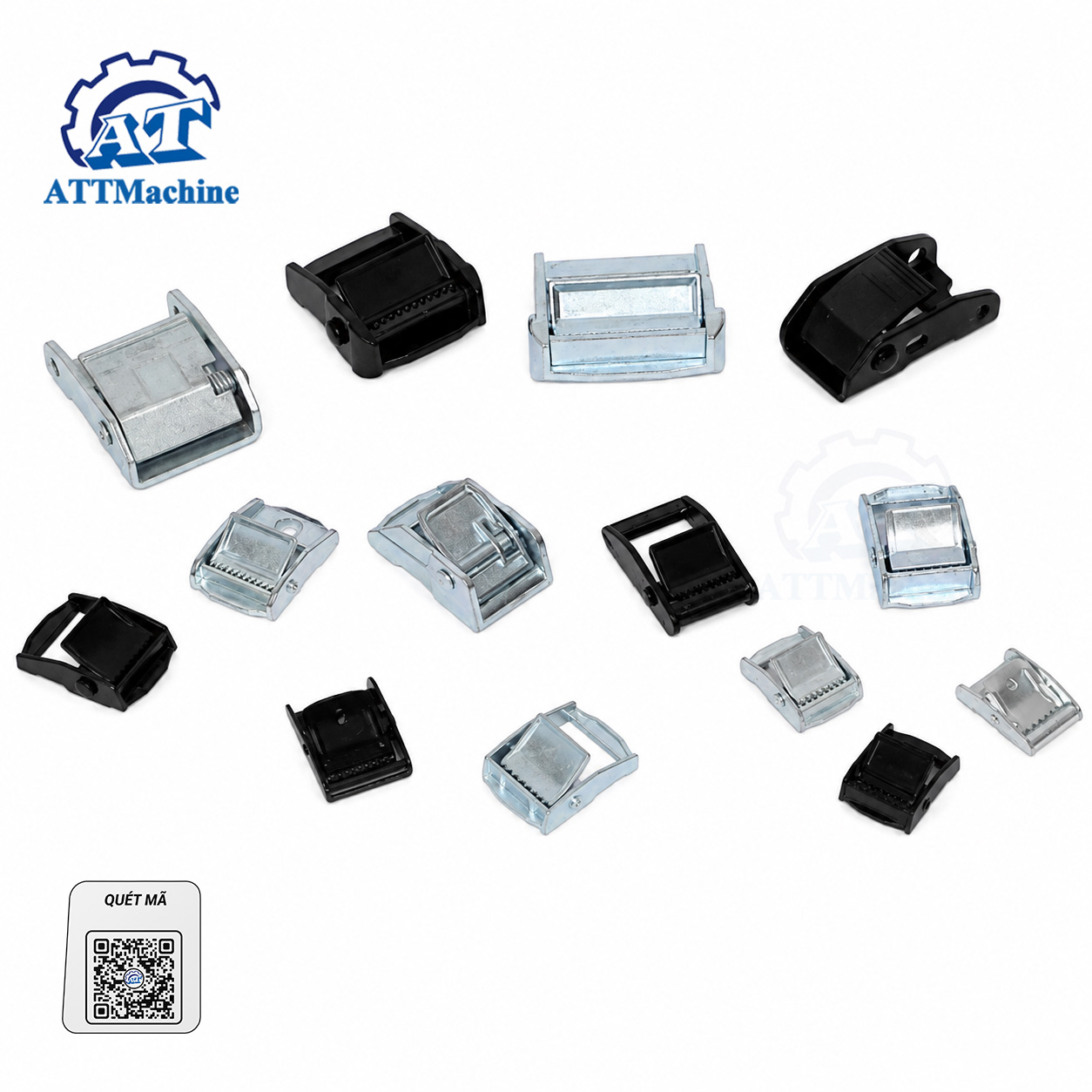
Custom manufacturing of cam buckles available upon request
Cam Buckle vs. Ratchet Buckle
Hardware selection depends entirely on tension needs and cargo fragility. Use cam buckles for fast, manual tensioning on light-to-medium loads, and ratchet buckles for maximum mechanical tie-down force
Technical Comparison:
| Operational Criteria | Cam Buckle | Ratchet Buckle |
| Tension Mechanism | Manual pulling (hand force via spring cam) | Mechanical cranking (spool and handle) |
| Operation Speed | Fast setup and quick-release | Multi-step tightening and controlled release |
| Overtightening Risk | Low (protects fragile or tubular cargo) | High (can easily crush delicate items) |
| Ideal Application | Light to medium-duty securing | Heavy-duty, high-tension industrial freight |
Engineering Warning: Cam buckles cannot replace ratchet buckles for heavy loads. Always select hardware based on the application's Working Load Limit (WLL) and tension requirements.
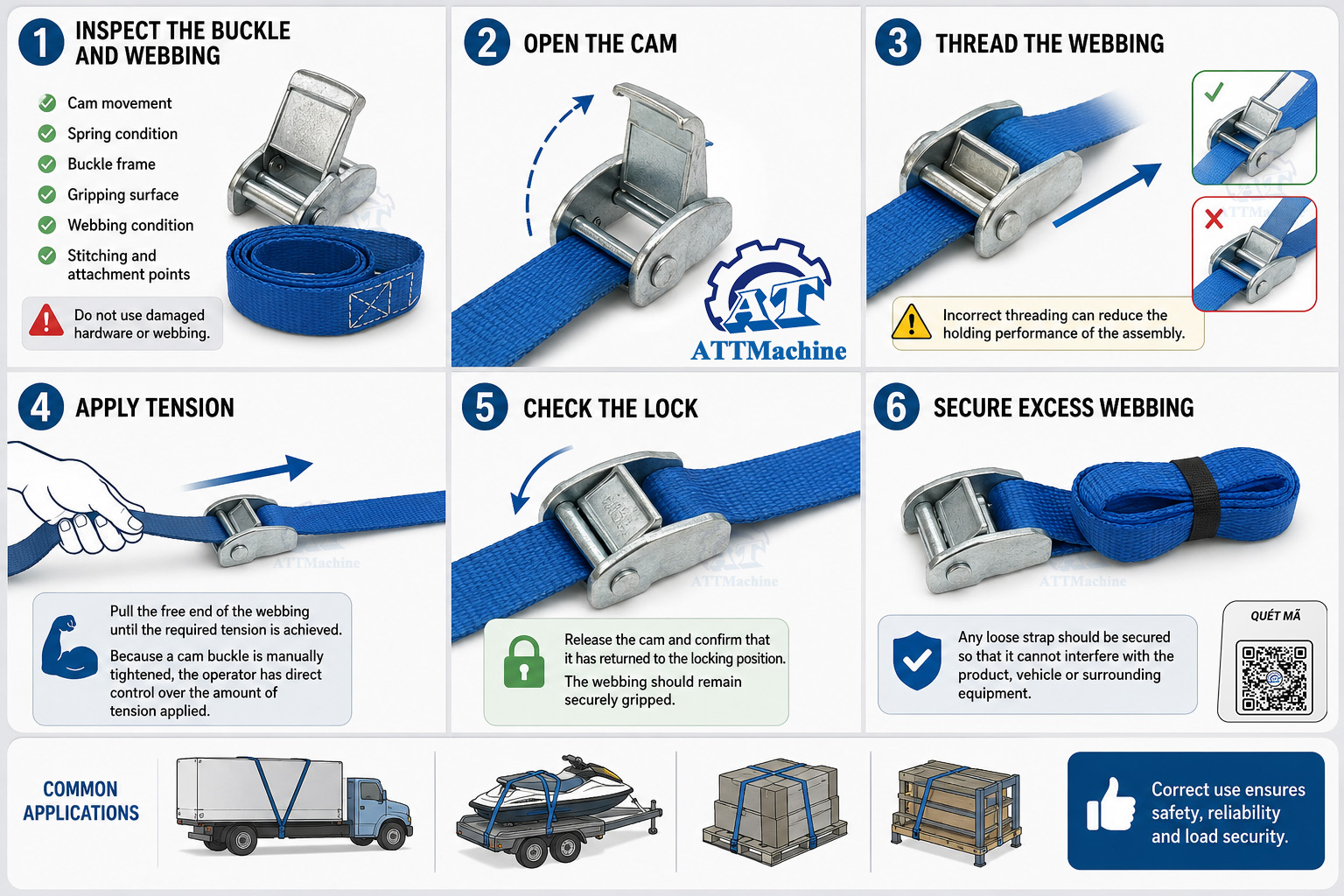
How Does a Cam Buckle Work?
While operating a cam buckle is straightforward, correct webbing routing is strictly required to maintain load security. Follow this standard operational sequence:
-
Inspect the Hardware: Verify the cam pivot movement, spring tension, and metal frame. Check the webbing for fraying or structural damage. (Never deploy compromised components).
-
Open the Mechanism: Press the thumb lever to lift the cam teeth and clear the internal feed path.
-
Thread the Webbing: Feed the strap precisely through the designated bottom slot. (Warning: Incorrect routing drastically degrades the assembly's holding performance).
-
Apply Manual Tension: Pull the free end of the strap until the load is secure. Manual operation provides direct control, protecting fragile cargo from over-tightening.
-
Lock and Validate: Release the lever. Confirm the internal spring forces the cam teeth to aggressively grip the webbing without slipping.
-
Secure Excess Slack: Tie off any remaining loose strap to prevent interference with vehicles, moving machinery, or surrounding equipment.
Cam buckle straps: Simple usage and safety guide
Where Are Cam Buckles Used?
Cam buckles provide quick, push-to-release strap adjustment for B2B applications where controlled manual tension is required and over-tightening must be avoided.
Primary Industry Applications
| Industry Sector | Typical Applications | Operational Context |
| Logistics & Freight | Light cargo, delivery equipment, bundling systems | Used for non-heavy freight where quick securing is prioritized over maximum tension. |
| Powersports & Cycling | Motorcycle tie-downs, bike carriers, transport accessories | Delivers controlled manual tension to securely hold vehicles without crushing tubular frames. |
| Marine & Recreation | Kayaks, canoes, paddleboards, camping gear | Simple mechanism allows fast, handle-free adjustments, ideal for wet or outdoor environments. |
| Commercial Transport | Furniture securing, fragile equipment moving | Prevents structural damage to delicate loads by strictly limiting tension to manual pulling force. |
Compliance & Safety Note: For regulated cargo transportation, always verify that the complete assembly meets local load certifications and Working Load Limit (WLL) standards. Because they rely entirely on manual pulling force, cam buckles are engineered to protect fragile cargo but must never replace heavy-duty ratchet systems for securing industrial payloads.
OEM Cam Buckle Manufacturing
ATT Machine engineers custom OEM cam buckles for B2B buyers requiring specialized designs, branded finishes, or proprietary configurations beyond standard catalog options.
Core OEM Development Parameters
To streamline custom production, our manufacturing framework focuses on three critical stages:
-
Design & Prototyping: Custom development from technical engineering drawings or direct reproduction of existing physical samples.
-
Technical Specifications: Precision matching for required webbing widths, specialized material alloys, and custom spring tension requirements.
-
Brand Customization: Applying specialized anti-corrosive surface treatments, engraved logo markings, and private-label packaging.
Engineering Support: Whether you supply a physical sample for reverse-engineering or a conceptual blueprint, our technical team rigorously validates all mechanical tolerances and application requirements before initiating mass production.
Custom Cam Buckle Manufacturing Process
A reliable OEM supply chain guarantees hardware consistency across repeated B2B orders through three core phases:
1. Pre-Production (Engineering & Planning)
Reviewing load applications, evaluating technical tolerances, and locking in the optimal metal alloys.
2. Fabrication & Assembly (Machining)
Stamping core metals, applying anti-corrosive surface treatments, and mechanically integrating the cam and spring mechanisms.
3. Post-Production (QA & Delivery)
Validating finished assemblies against exact dimensional specs and configuring custom private-label packaging for bulk freight.
Cam Buckle QA & Inspection Protocol
A strict Quality Assurance (QA) program must validate both dimensional accuracy and mechanical reliability before final assembly.
| Inspection Phase | Critical Checks |
| Physical Specs | Material alloy, dimensional tolerances, and surface finish. |
| Mechanics | Cam pivot movement, spring tension, and webbing feed. |
| Performance | Tensile strength, locking grip, and Working Load Limit (WLL). |
OEM Requirement: Define your Quality Acceptance Criteria (QAC) before mass production to guarantee the buckle integrates flawlessly with your custom straps, hooks, and stitching patterns.
How to Choose the Right Cam Buckle for B2B Applications
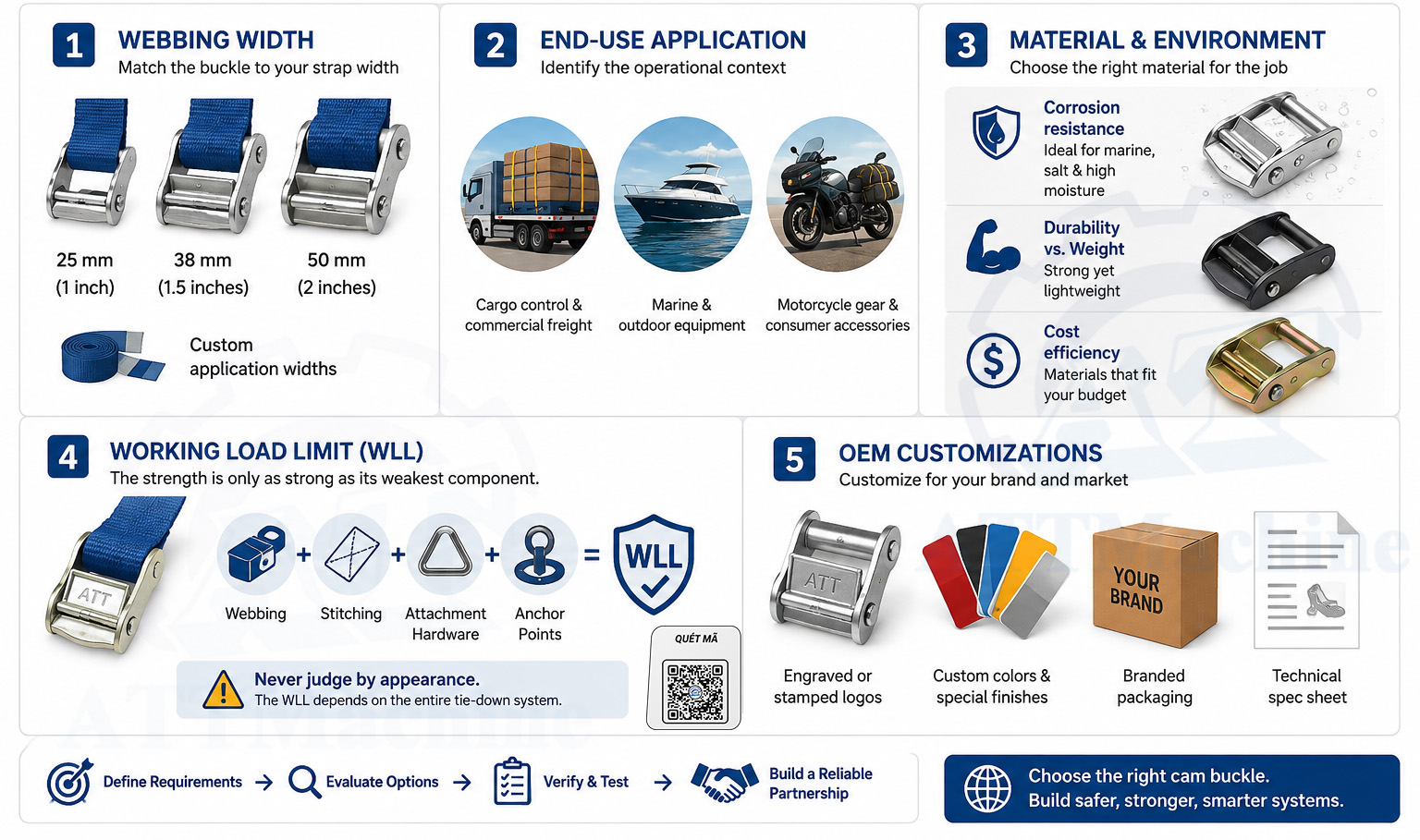
To select the correct cam buckle, B2B buyers must evaluate five core specifications: webbing width, end-use environment, material durability, system load capacity, and OEM requirements.
1. What is the required webbing width?
The buckle must perfectly match the strap dimensions to prevent slippage. Standard industrial sizes include:
- 25 mm (1 inch)
- 38 mm (1.5 inches)
- 50 mm (2 inches)
Custom application widths
2. What is the end-use application?
Identify the operational context to determine the necessary design profile:
- Cargo control and commercial freight
- Marine and outdoor equipment
- Motorcycle gear and consumer accessories
3. Which material suits the operational environment?
Select the metal alloy and surface coating based on physical constraints:
- Corrosion resistance: Essential for marine, salt, or high-moisture environments.
- Durability vs. Weight: Balancing mechanical strength with logistical weight limits.
- Cost efficiency: Aligning manufacturing materials with budget targets.
4. What is the Working Load Limit (WLL) of the assembly?
Never evaluate a cam buckle based solely on appearance. The load capacity depends on the entire tie-down system, as the weakest component dictates the maximum performance limit:
Cam Buckle + Webbing + Stitching + Attachment Hardware + Anchor Points
5. Are OEM customizations required?
For private-label distribution, define specific manufacturing and branding modifications:
- Engraved or stamped brand logos
- Custom colors and specialized surface finishes
- Branded packaging and technical specification sheets
Commercial-grade cam buckle cargo strap - ATTmachine
Common Cam Buckle Problems
Most tie-down failures stem from routine wear, mismatched specs, or structural damage. Diagnose these core issues immediately to ensure operational safety.
Why does a cam buckle slip?
Slipping is triggered by dimension mismatch, mechanical wear, or capacity overload.
- Spec Mismatch: Incorrect webbing width, improper threading, or incompatible material.
- Component Wear: Dulled gripping teeth, weakened spring, or frayed straps.
- System Overload: Tension exceeding the Working Load Limit (WLL).
Why does a cam buckle fail to lock?
Locking mechanisms fail when physically obstructed or structurally deformed.
- Obstruction: Dirt, grease, or debris jamming the cam’s pivot.
- Hardware Failure: A broken, weak, or misaligned return spring.
- Deformation: Bent metal frame or improperly seated webbing.
When should you replace a cam buckle?
Remove the buckle from service immediately if visual inspection reveals physical degradation.
- Structural Damage: Cracks, bent frames, or severe metal corrosion.
- Cam Wear: Stripped, dulled, or broken gripping teeth.
- Mechanism Failure: Inconsistent locking action or a dead spring.
Why Choose ATT Machine for Cam Buckles?
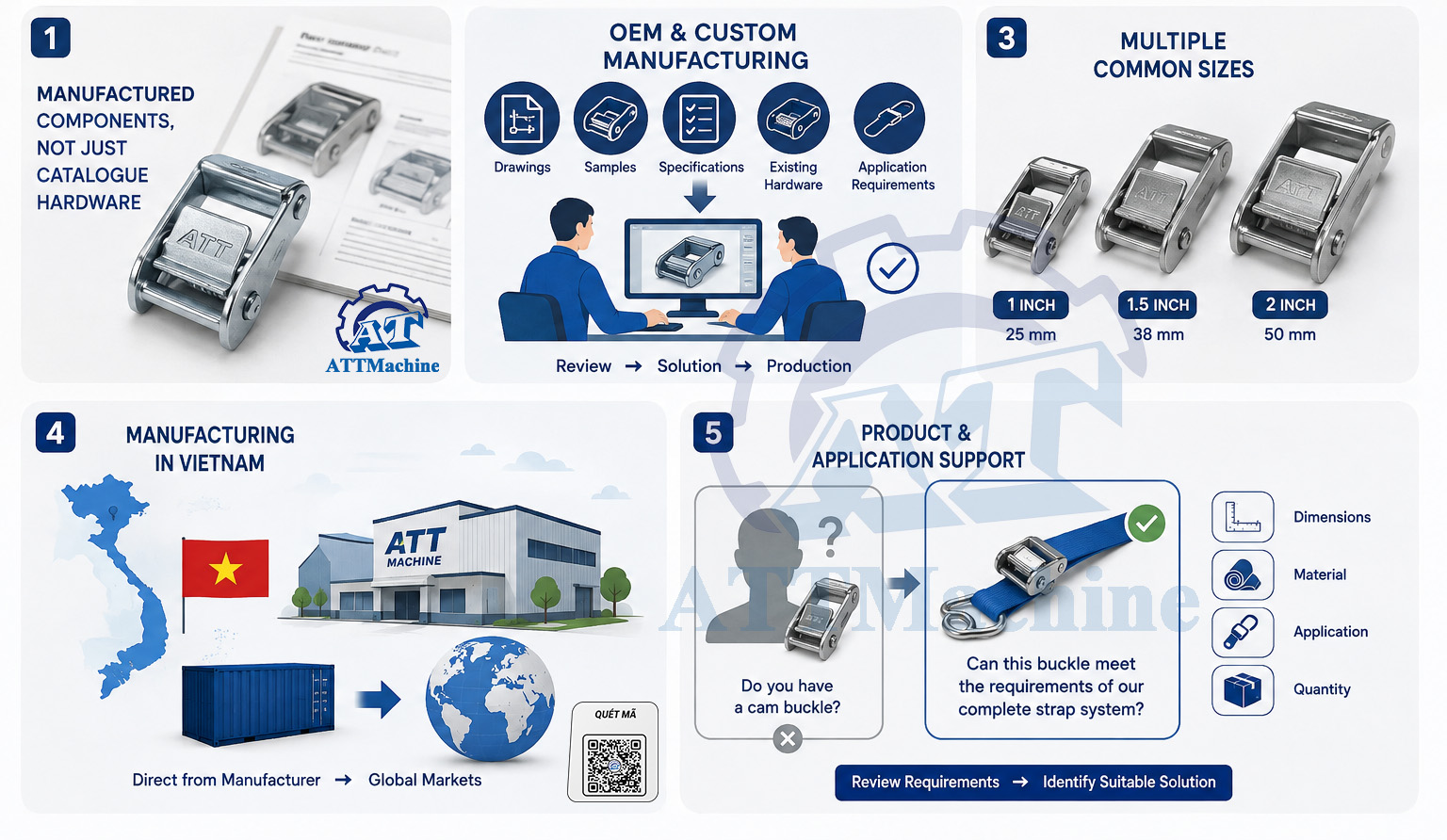
ATT Machine approaches cam buckles as manufactured components, not simply catalogue hardware.
Our capabilities are focused on helping international buyers source metal components and tie-down hardware according to defined product requirements.
OEM and Custom Manufacturing
Customers can provide: Drawings, Samples, Product specifications, Existing hardware, Application requirements
The manufacturing team can then review the project and determine a suitable production approach.
Multiple Common Sizes
The cam buckle range includes common: 1 inch / 25 mm, 1.5 inch / 38 mm, 2 inch / 50 mm
Manufacturing in Vietnam
ATT Machine operates as a Vietnam-based manufacturer serving international customers. This gives B2B buyers an option for sourcing tie-down hardware directly from a manufacturing partner rather than purchasing through multiple trading layers.
Product and Application Support
For OEM projects, the important question is not simply:
“Do you have a cam buckle?”
The more useful question is:
“Can this buckle meet the requirements of our complete strap system?”
ATT Machine can review the required dimensions, material, application and quantity to help identify a suitable manufacturing solution.
Attmachine - Leading cam buckle supplier in Vietnam
Frequently Asked Questions
What is a cam buckle used for?
A cam buckle is used to tighten and secure webbing straps. It is commonly selected for applications requiring quick adjustment and manual tensioning.
Is a cam buckle stronger than a ratchet buckle?
Not necessarily. Cam and ratchet buckles use different tensioning mechanisms and are designed for different applications. The appropriate choice depends on the complete strap assembly and required load performance.
What sizes of cam buckles are available?
Common sizes include 1 inch (25 mm), 1.5 inch (38 mm) and 2 inch (50 mm). Other sizes or configurations may be available for custom projects.
Can ATT Machine manufacture custom cam buckles?
Yes. ATT Machine can review custom requirements based on drawings, samples, dimensions, material and application.
Can I order cam buckles in bulk?
Yes. ATT Machine supports wholesale and OEM production requirements. Quantity, packaging and production requirements should be confirmed during quotation.
Can you add our logo?
Custom branding may be available depending on the buckle design, marking method and order requirements.
Can I buy complete cam buckle straps instead of buckles only?
Complete cam buckle strap assemblies can be discussed according to the required webbing, length, hooks, stitching and packaging configuration.
How do I choose between a cam buckle and a ratchet buckle?
Choose a cam buckle when quick operation and controlled manual tension are important. Consider a ratchet buckle when the application requires substantially greater mechanical tension.
Always select the system according to the required load rating and applicable safety requirements.
Request a Cam Buckle Quote from ATT Machine
Looking for a cam buckle manufacturer, OEM supplier or wholesale source in Vietnam?
Send ATT Machine the basic information about your project: Cam buckle size, Webbing width, Material, Surface finish, Estimated quantity, Application, Required load or test specification, Logo or branding requirements, Packaging requirements, Product drawing or sample, if available
Our team can review your requirements and recommend a suitable manufacturing configuration.
Company: ATTMachine Mechanical Co., Ltd
Phone / WhatsApp / Zalo: +84 942 127 028
Email: cokhi.anthanhtech@gmail.com
Factory: No. 5, Vo Van Bich St., Ho Chi Minh City, Vietnam
For international OEM projects, providing a drawing, sample or detailed product specification will help us evaluate the requirement more accurately.
Request a quotation for your cam buckle project today


