
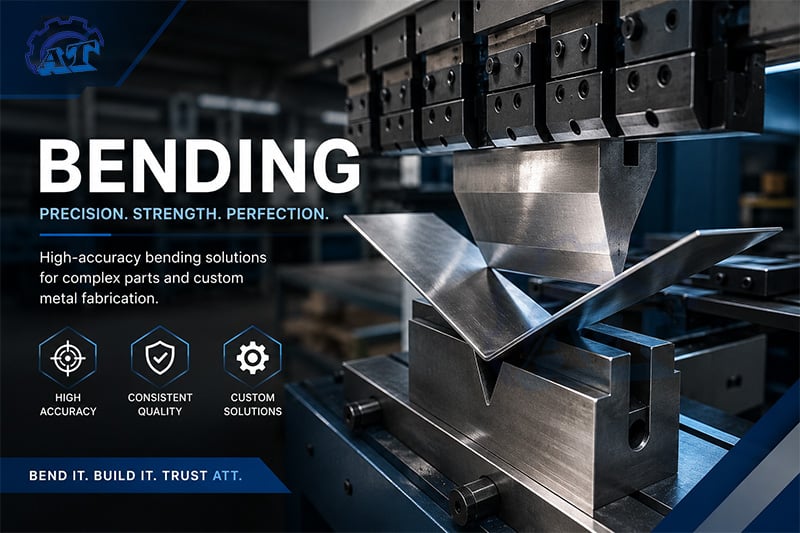
Custom Sheet Metal Bending Services for OEM & Industrial Manufacturing
ATT Machine provides custom sheet metal bending services for OEMs, manufacturers and industrial buyers requiring precision-formed metal components.
We manufacture bent sheet metal parts from customer drawings, CAD files or samples, supporting prototype, low-volume and repeat production. Our manufacturing workflow can combine CNC press brake bending with laser cutting, welding, surface finishing and quality inspection.
Based in Ho Chi Minh City, Vietnam, ATT Machine works with international customers looking for a direct manufacturing partner for custom metal components.
Need a quote? Send us your drawing, material, thickness and quantity for a manufacturing review.
Sheet Metal Bending Capabilities
| Capability | Details |
|---|---|
| Process | CNC Press Brake Bending |
| Production | Prototype, Low Volume & Production |
| Materials | Stainless Steel, Carbon Steel, Aluminum & Other Metals |
| Parts | Brackets, Panels, Enclosures, Frames & Custom Components |
| Engineering | Drawing Review & DFM Support |
| Secondary Processes | Laser Cutting, Welding & Finishing |
| Manufacturing Location | Ho Chi Minh City, Vietnam |
| Customers | OEMs, Manufacturers & Industrial Buyers |
Actual bending capacity and achievable tolerances depend on material grade, thickness, part geometry, bend length, tooling and machine configuration.
What Is Sheet Metal Bending?
Sheet metal bending is a manufacturing process that forms flat metal sheets into angles, channels, boxes and other three-dimensional shapes using controlled force.
CNC press brakes are commonly used because they allow bending parameters, tooling and bend sequences to be controlled according to the part drawing.
Typical applications include:
-
Brackets and mounting parts
-
Electrical enclosures
-
Machine covers and guards
-
Control panels
-
Frames and channels
-
Industrial equipment components
-
Custom OEM parts
For many products, bending is combined with laser cutting and welding to create a finished fabricated component.
CNC Press Brake Bending for Custom Parts
The bending process begins with the approved drawing and material specification.
ATT Machine reviews the part geometry, bend locations, material thickness, bend radius and required tolerances before production.
The typical workflow is:
Drawing Review → Flat Pattern → Cutting → Deburring → CNC Bending → Inspection → Secondary Fabrication → Packaging
For complex components, the bending sequence is planned to minimize tool interference and dimensional variation.
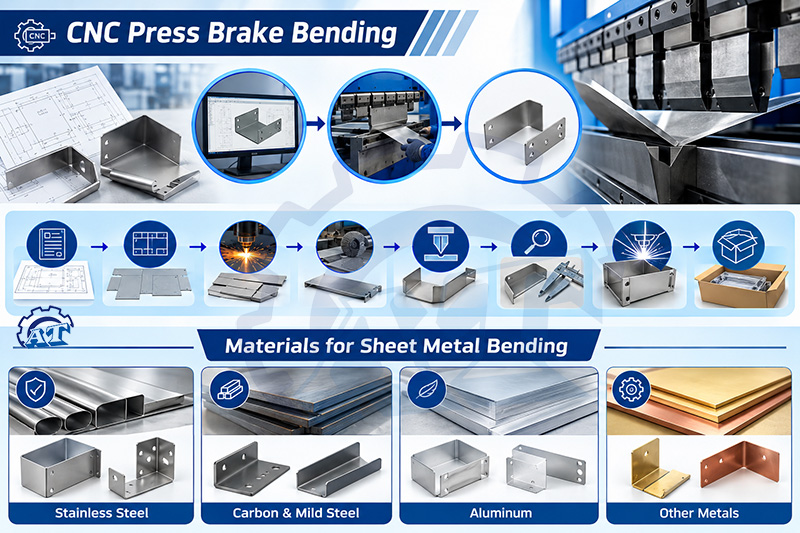
CNC Press Brake Bending Workflow Infographic - ATTmachine
Materials for Sheet Metal Bending
Stainless Steel
Stainless steel is commonly used for industrial equipment, enclosures, food-processing equipment and applications requiring corrosion resistance.
Common grades include 304 and 316, depending on project requirements.
Carbon and Mild Steel
Carbon steel is widely used for machine frames, brackets, panels, guards and structural components.
Aluminum
Aluminum is useful when low weight and corrosion resistance are important.
Common alloys used in fabricated components include 5052 and 6061. The suitable alloy, bend radius and forming method depend on the final application.
Other Metals
Depending on the project, ATT Machine can review requirements for materials such as galvanized steel, brass and copper.
Material grade should always be specified on the drawing or RFQ because different grades can behave differently during bending.
Sheet Metal Bending Tolerances and Design
Bending accuracy is affected by more than the CNC machine.
Material properties, thickness, bend length, tooling, springback and part geometry can all influence the final result.
Bend Angle
The required bend angle should be clearly identified on the technical drawing, especially for parts with assembly or functional requirements.
Bend Radius
The inside bend radius should be selected according to the material and thickness.
A radius that is too small can increase the risk of cracking or deformation.
Bend Allowance and K-Factor
When a sheet is bent, the material stretches and compresses around the bend.
Bend allowance and K-factor are therefore important when developing the flat pattern for a finished part.
Hole-to-Bend Distance
Holes and slots positioned too close to a bend may deform during forming.
The distance should be reviewed together with material thickness, tooling and bend radius.
Bend Relief
Bend relief can help prevent tearing and deformation where a bend terminates near an edge or corner.
Multi-Bend Parts
Parts with several bends require careful bend sequencing.
The sequence should consider tool access, part orientation and interference between the component and the press brake tooling.
Design for Manufacturability (DFM) Review
A good sheet metal part should be designed not only to meet its function but also to be practical to manufacture.
Before production, ATT Machine can review:
-
Material and thickness
-
Bend radius
-
Bend sequence
-
Hole and slot locations
-
Tool access
-
Part geometry
-
Required tolerances
-
Potential forming issues
This early review can help identify manufacturing problems before production begins.
Recommended File Formats
For quotation and engineering review, customers can provide:
-
STEP / STP
-
DXF
-
DWG
-
PDF
-
IGES
For the most accurate quotation, include the material grade, thickness, quantity and critical tolerances.
From Laser Cutting to Finished Bent Parts
Many sheet metal components begin as a flat laser-cut blank.
ATT Machine can coordinate multiple fabrication processes according to project requirements:
1. Laser Cutting
The flat pattern, holes, slots and cutouts are produced from the approved drawing.
2. Deburring
Sharp edges and cutting burrs are removed where required.
3. CNC Bending
The flat blank is formed into the required three-dimensional geometry.
4. Welding
Separate bent components can be welded when the final assembly requires it.
5. Surface Finishing
Finishing processes can be added according to the application and customer specification.
6. Quality Inspection
Finished parts are checked against the applicable drawing and quality requirements.
This integrated workflow can reduce the need to coordinate several suppliers for a custom fabricated component.
Quality Control for Sheet Metal Bending
Quality control should be based on the actual requirements of the part rather than a generic accuracy claim.
ATT Machine's inspection process can include checks for:
-
Overall dimensions
-
Bend angles
-
Hole locations
-
Part geometry
-
Surface condition
-
Material requirements
For OEM production, critical dimensions and inspection requirements should be identified during quotation and drawing review.
Where required by the project, customers can discuss applicable inspection and material documentation before production.
Custom Sheet Metal Bending Applications
Our custom bending services are suitable for components used in:
Industrial Machinery
Machine covers, guards, brackets, frames and structural components.
Automation & Robotics
Mounting brackets, housings, support structures and custom machine components.
Electrical & Electronics
Enclosures, control panels, cabinets and chassis components.
Automotive & Transportation
Prototype components, brackets and formed metal structures.
Food Processing
Stainless steel panels, covers, hoppers and fabricated equipment components.
OEM Equipment
Custom parts manufactured according to customer drawings and specifications.
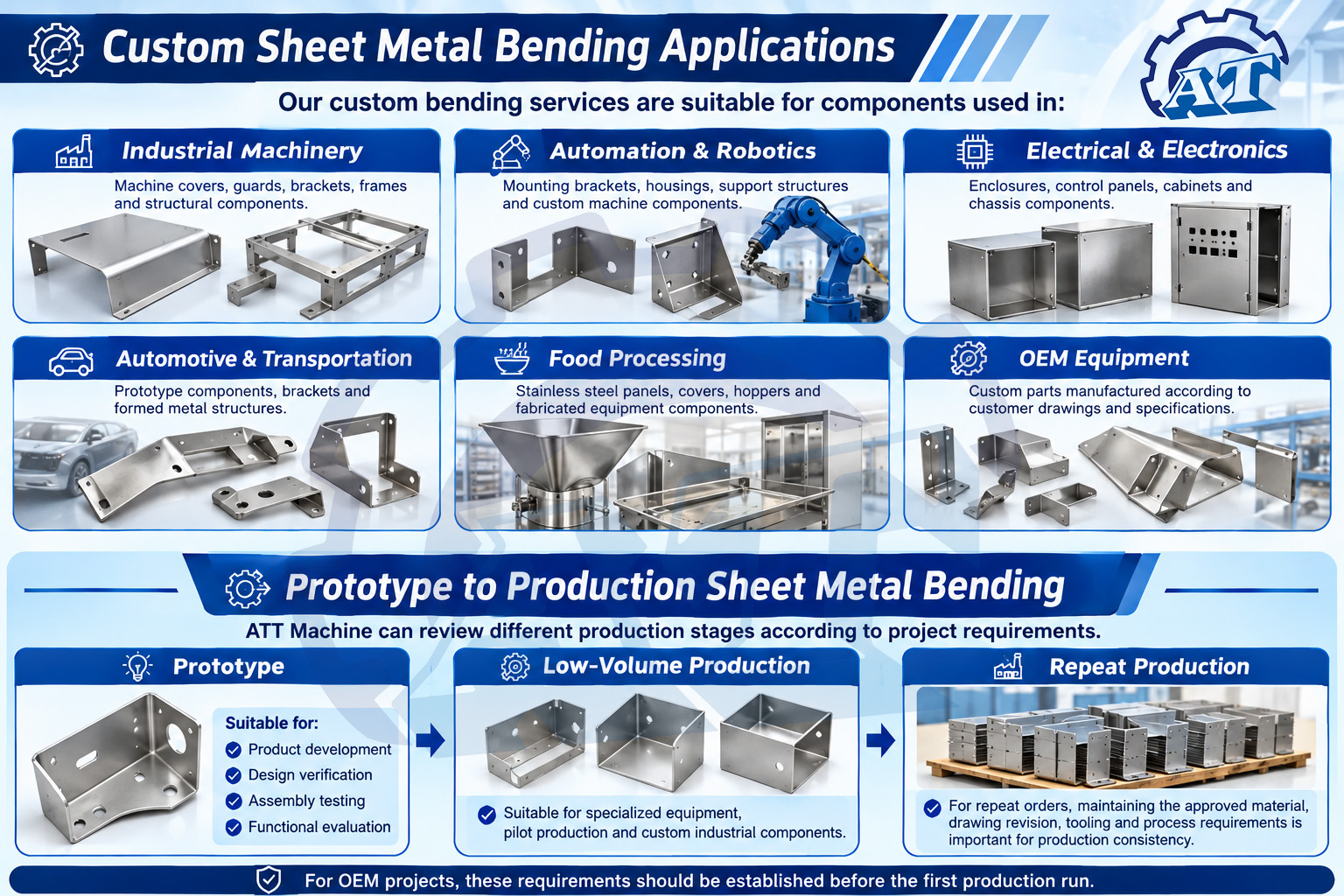
Sheet Metal Bending - ATT Machine
Prototype to Production Sheet Metal Bending
ATT Machine can review different production stages according to project requirements.
Prototype
Suitable for:
-
Product development
-
Design verification
-
Assembly testing
-
Functional evaluation
Low-Volume Production
Suitable for specialized equipment, pilot production and custom industrial components.
Repeat Production
For repeat orders, maintaining the approved material, drawing revision, tooling and process requirements is important for production consistency.
For OEM projects, these requirements should be established before the first production run.
Our Sheet Metal Bending Process
1. Submit Your Drawing
Send your CAD file, PDF drawing or sample information.
2. Engineering Review
We review material, geometry, bending requirements and manufacturability.
3. Quotation
The quotation is based on material, quantity, part complexity, bending operations and additional processes.
4. Production
Approved parts are cut, formed and fabricated according to the project requirements.
5. Inspection
Critical dimensions and specified quality requirements are checked.
6. Packaging & Shipping
Finished parts are packed according to the project and shipping requirements.
Why Choose ATT Machine for Custom Metal Bending?
Direct Manufacturing in Vietnam
ATT Machine operates from Ho Chi Minh City, Vietnam, providing custom metal manufacturing for domestic and international customers.
Engineering-Focused Production
We evaluate the drawing and manufacturing requirements before production rather than treating bending as a standalone machine operation.
Multiple Fabrication Processes
Customers can combine bending with laser cutting, welding and other fabrication processes according to the project.
Custom OEM Manufacturing
Parts are produced according to customer drawings, specifications and application requirements.
Prototype to Repeat Production
The same manufacturing partner can support development, sampling and subsequent production when the project progresses.
Sheet Metal Bending Manufacturer in Vietnam for International Buyers
ATT Machine supports international OEMs and industrial buyers sourcing custom bent metal components from Vietnam.
For overseas projects, we recommend providing complete technical information at the RFQ stage, including:
-
Part drawing
-
Material grade
-
Thickness
-
Quantity
-
Critical tolerances
-
Surface finish
-
Packaging requirements
-
Delivery destination
This allows the manufacturing and quotation requirements to be evaluated more accurately.
ATT Machine is a Vietnam-based manufacturer, not a local factory in the United States, Japan or Australia. International customers can work directly with our manufacturing team for custom production projects.
What Affects Sheet Metal Bending Cost?
There is no single price per meter or bend that accurately applies to every project.
The final cost depends on:
-
Material and grade
-
Sheet thickness
-
Part dimensions
-
Number of bends
-
Bend complexity
-
Tooling
-
Production quantity
-
Secondary operations
-
Inspection requirements
-
Packaging and shipping
For this reason, a drawing-based quotation is more reliable than a generic online price list.
How to Request a Sheet Metal Bending Quote
For a fast and accurate project review, send:
1. Drawing or CAD file 2. Material and grade 3. Sheet thickness 4. Quantity 5. Required tolerances 6. Surface finish 7. Delivery location
Our team can review the requirements and determine whether the part is suitable for CNC bending and integrated sheet metal fabrication.
Frequently Asked Questions
What is sheet metal bending?
Sheet metal bending forms a flat metal sheet into a required angle or shape using controlled force, typically with a CNC press brake.
What materials can you bend?
ATT Machine can review stainless steel, carbon steel, mild steel, aluminum and other metals according to material grade, thickness and part geometry.
Can you manufacture custom OEM parts?
Yes. Custom parts can be manufactured from customer drawings, CAD files or approved samples.
Can you make prototypes?
Prototype projects can be reviewed before moving to low-volume or repeat production.
Can bending be combined with laser cutting?
Yes. Laser cutting and CNC bending can be combined for projects requiring complete sheet metal fabrication.
What files should I send?
STEP, STP, DXF, DWG, PDF and IGES files are suitable for engineering and quotation review.
What determines bending accuracy?
Material properties, thickness, tooling, bend radius, machine setup, springback and part geometry all affect the final result.
Can you manufacture multi-bend parts?
Yes. Multi-bend components can be reviewed based on geometry, tooling access and bend sequence.
Do you serve international customers?
Yes. ATT Machine is based in Vietnam and supports international OEM and industrial manufacturing projects.
Request a Custom Sheet Metal Bending Quote
Have a sheet metal bending project?
Send your drawing and project requirements to ATT Machine for manufacturing review.
ATT Machine - Custom Metal Manufacturing in Vietnam
Phone / WhatsApp: +84 942 127 028
Email: cokhi.anthanhtech@gmail.com
Location: Ho Chi Minh City, Vietnam
Submit your drawing to discuss your custom sheet metal bending project.

